Home / Services / House & Building Settlement

Cracks in your walls, a porch pulling away, doors that no longer close? Geocon (M) Sdn. Bhd. provides building settlement repair in Malaysia that fixes the ground under your house, not just the cracks on top. We stabilise the foundation with helical piles or polyurethane injection, with no hacking and no heavy machinery.

Sinking house & building settlement repair in Malaysia

Is your house sinking? Signs to look for

Settlement usually starts slowly. Check your house against this list. Two or more of these together is a strong sign that the ground under part of the building is moving.

  • Cracked wallsDiagonal cracks running from the corners of doors and windows, or cracks that are wider at one end.
  • Sinking porch or car porchThe porch slab has dropped, tilted or opened a gap where it meets the house.
  • Extension pulling awayA gap or crack line where the kitchen or extension joins the original house.
  • Doors and windows stickingFrames pushed out of square, so doors scrape, jam or will no longer lock.
  • Sloping or hollow floorsTiles cracking or lifting, a ball rolls to one side, or the floor sounds hollow.
  • Gaps at skirting and floorA gap opening between the floor and the wall, or along the skirting tiles.
  • Cracked drains around the houseBroken drains, water pooling, or soil washing out near the foundation.
  • Cracks that keep growingCracks you have patched before that open up again, or new ones each rainy season.

Seeing two or more of these? Have it checked before the cracks grow.

Why houses sink in Malaysia

Cracks are the symptom. The cause is almost always in the soil below the foundation.

Soft ground and poorly compacted fill

Many housing areas in Selangor and the Klang Valley are built on soft clay or on fill that was not compacted properly. Over the years the soil squeezes together under the weight of the house (consolidation), and the building slowly settles with it.

Water washing the soil away

Leaking drains, broken pipes and heavy rain can carry fine soil out from under a slab. This leaves voids and cavities (soil piping). Malaysia's wet weather, with the groundwater rising and falling through the year, makes this worse and can cause compacted fill to collapse.

Differential settlement: when one part sinks more

Differential settlement means one part of a building settles more than another. It is the most common cause of cracked walls in terrace houses. A typical case: the original house sits on piles, but the kitchen, porch or extension added later was built on a shallow footing. The extension sinks with the soft soil while the house stays put, and the joint between them cracks.

Simply patching the cracks or recasting the slab does not stop this. New concrete adds more weight to the same weak soil, so the problem usually comes back. Proper building settlement repair deals with the ground first.


How we repair a sinking house, step by step

Every job starts with testing, so the repair is designed for your soil, not guessed.

  1. Inspect & test

    We map the cracks, take a laser level survey of floors and slabs, and run JKR/Mackintosh probe tests to find how deep the weak soil goes.

  2. Design the fix

    Based on the test results, we choose helical piles, PU injection or both, and work out the number, depth and spacing of piles or injection points.

  3. Install

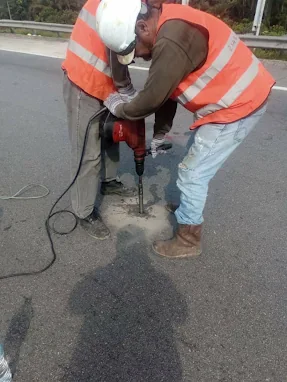
    Helical piles are screwed in by rotation beside the footing; PU is injected through small drilled holes. No hacking, no excavation and no heavy machinery.

  4. Support & level

    Piles are bracketed to the existing footing to carry the load. Where slabs have dropped, PU lifts them in small stages under a laser level.

  5. Monitor & hand over

    We re-test the ground and can set settlement monitoring points to confirm the building has stopped moving before cracks are repaired.

Our two repair systems

Both are backed by research with GeoForenSIG, the geotechnical forensic group at UiTM's Faculty of Civil Engineering.

Assoc. Prof. Ir. Dr. Ismacahyadi Bagus Mohamed Jais

Leads GeoForenSIG, Faculty of Civil Engineering, Universiti Teknologi MARA (UiTM). Technical partner to Geocon (M) Sdn. Bhd.

[CREDENTIALS e.g. professional registration]

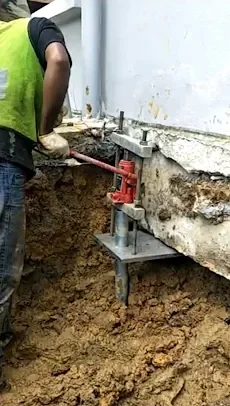
Helical pile underpinning bracket installed against the footing of a settled house
Underpinning

GeoMicroHelicS helical piles

Steel piles with helix-shaped plates are screwed into firm ground below the soft layer, then fixed to the footing so the building rests on them instead of the weak soil.

  • Shaft: extendable round shaft, 70–114 mm
  • Helix plates: 150–400 mm diameter
  • Capacity: about 14–93 tonnes per pile, by size and steel grade
  • Best for: walls and footings that keep sinking
Helical pile underpinning
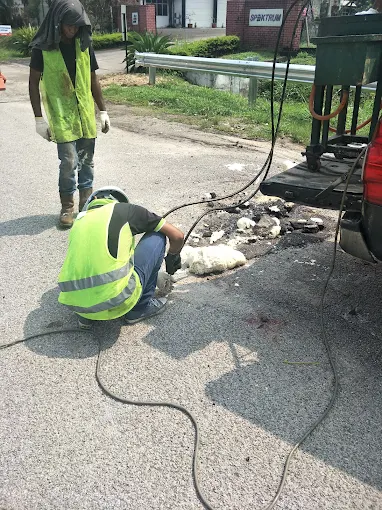
Polyurethane foam rising through cracks during PU injection to fill voids under a slab
Ground injection

PolyGeo PU injection

High-pressure hydrophobic polyurethane is injected through small holes. It expands, pushes out water, fills voids and compacts the soil, and can lift a sunken slab back to level.

  • Expansion: 6–20 times its liquid volume
  • Access: small drilled holes, no excavation
  • Weight: lightweight, adds almost no load
  • Best for: sunken floors, porches and voids
Polyurethane injection

Why repair this way

Underpinning and injection treat the cause of differential settlement, so the repair lasts.

  • No demolition. Floors, tiles and walls stay in place. Work is done through small holes or beside the footing.
  • No heavy machinery. Helical piles are installed by rotation, so the equipment fits into terrace-house back lanes, porches and kitchens.
  • No extra load on soft soil. Unlike new concrete or extra fill, helical piles and PU foam don't add overburden to the ground that caused the problem.
  • Measured, not guessed. Probe tests and level surveys before and after show that the ground has been strengthened.

Where we repair settlement

  • Terrace, semi-detached and bungalow houses
  • House extensions, rear kitchens and car porches that have sunk away from the main house
  • Shophouses and low-rise buildings with cracked walls
  • Factories and warehouses with settling floors or column bases
  • Homes next to sinkholes, broken drains or eroded ground

Related project

Helical pile underpinning at a house footing
Residential underpinning · Seksyen 7, Shah Alam

Underpinning a settled house with helical piles

For a house in Seksyen 7, Shah Alam, we designed GeoMicroHelicS helical piles for each support point, checking the load capacity of every pile against the soil layers found by testing. After installation, four settlement markers around the house were monitored over several months in 2019.

[CONFIRM: original problem, number of piles, and that the 2019 monitoring readings (movement within about ±3 mm) may be published.]

See all projects

Frequently asked questions

Why is my house sinking?

Usually because the soil under part of the foundation is soft, was poorly compacted when the house was built, or is being washed away by water from leaking drains or pipes. Extensions and porches built on shallow footings next to a piled house are especially prone to sinking.

What are the signs of foundation settlement?

Diagonal cracks from door and window corners, doors and windows that stick, sloping floors, a porch or extension separating from the house, and gaps opening at the skirting. Cracks that reopen after patching are a strong sign the ground is still moving.

Is a settlement crack dangerous?

Not every crack is serious, but a crack caused by settlement means the structure is moving. Cracks that are wider than a few millimetres, keep growing, or come with doors jamming and floors tilting should be checked by an engineer soon. If you see sudden large cracks, falling plaster or a ceiling sagging, leave that area and get help straight away.

Can a sinking house be fixed?

Yes. In most cases a sinking house can be stabilised without demolition, by underpinning the footing with helical piles and/or injecting polyurethane to fill voids and strengthen the soil. Once the ground stops moving, the cracks can be repaired and will stay closed.

How much does it cost to repair a sinking house?

It depends on how much of the house is affected, how deep the soft soil goes, and whether piles, injection or both are needed. We can give a proper quotation after a site inspection and testing. Request a site inspection.

Should I use helical piles or PU injection?

Helical piles are best when a wall or footing keeps sinking and needs new support from firmer ground below. PU injection is best for sunken slabs, voids and loose soil close to the surface. Many houses need a combination, which we decide from the test results.

Do I need to break the floor or move out?

Usually not. PU injection works through small holes, and helical piles are installed beside the footing, so floors and walls stay in place. We will tell you after the inspection if any area needs to be cleared during the works.

Related services

Tell us what's moving. We'll tell you how to fix it.

Send us a photo of the problem.

Call us WhatsApp us

Talk to us

Choose who to contact. WhatsApp photos of the problem and your site location for a faster answer.

Mon–Fri, 9am–5pm

Send an enquiry form instead