

Home / Services

Two core services and one method: high-pressure polyurethane injection through small drilled holes. No excavation and no new foundations.

Ground repair, from below.

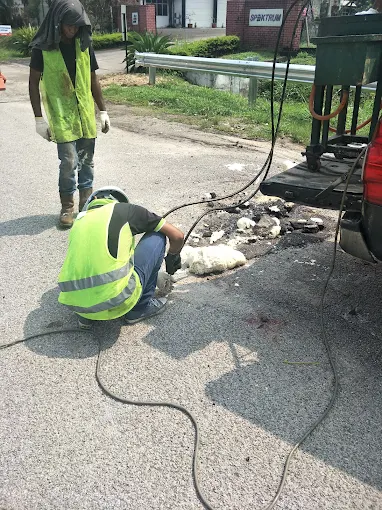
Polyurethane foam rising through cracks in a road pavement during injection
Service 01

Slab uplifting & re-levelling

Expanding polyurethane is injected under a sunken slab to fill the gap and raise it back to level. We lift in small, controlled stages while a laser level tracks the slab.

Typical jobs

  • Factory, warehouse and loading-bay floors
  • House porches, car porches and driveways
  • Road pavements, aprons and drains
  • Approach slabs at bridges and culverts

Because the slab stays in place, there's no hacking, no recasting and very little disruption to the people working around it.
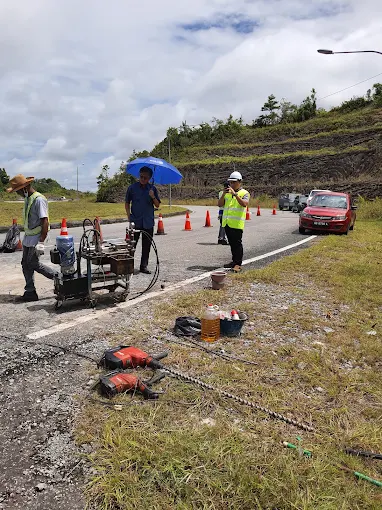
Geocon team operating the injection rig at the edge of a highway embankment
Service 02

Soil stabilisation on soft ground

Polyurethane resin is pumped into weak or loose soil at high pressure. It expands, fills voids, pushes out water and compacts the soil around it, so the ground can carry load again.

Typical jobs

  • Settlement under buildings and structures
  • Loose or poorly compacted fill
  • Transition zones between embankments and piled structures
  • Ground weakened by water trapped below the surface

The foam is lightweight, so it strengthens the ground without adding the extra load that new concrete or fill would put on soft soil.

Where else we inject.

The same system is used for voids, approaches and slopes, wherever the ground below a structure has moved or washed away.

Void & sinkhole filling

Cavities below slabs and pavements, and soil piping caused by leaking underground drains, are filled and sealed. The foam is water-repellent, which helps keep water from getting back in.

Bridge & culvert approaches

Where an earth embankment meets a piled bridge or culvert, the fill often settles and leaves a bump. We fill the voids beneath the approach slab and stabilise the migrated soil.

Slopes & rock

PU resin can be injected into fractures, joints and fissures in a rock slope, binding the rock mass together and increasing its strength.

How a slab goes back to level.

Most jobs follow the same four steps. The work happens through holes small enough to patch afterwards, so floors and roads stay in place.

Cross-section of a slab being lifted by polyurethane injection A concrete slab that has sunk on one side over loose fill and soft soil. Polyurethane is injected through tubes, expands to fill voids beneath, and lifts the slab back up to the laser level line. Laser level datum Slab has sunk with the soil below it PU expands, fills voids, lifts slab to level Loose fill Soft soil Firm stratum
Simplified section, not to scale
  1. Inspect & test

    We visit the site, map where the ground has dropped and run probe tests to find how deep the weak soil goes.

  2. Drill small holes

    Small-diameter holes are drilled through the slab or pavement at planned spacing, and injection tubes are set in place.

  3. Inject & lift

    Polyurethane is pumped in under pressure and expands within minutes. We lift in small stages, watching a laser level throughout.

  4. Re-test & hand over

    We test the ground again, seal the holes and hand the area back once the foam has cured, typically after a few hours.

Technical data

The material.

We use hydrophobic polyurethane, which expands 6 to 20 times its liquid volume and pushes water out as it sets. It is light, strong and close to watertight once cured.

Typical values from Geocon's technical presentation. Every job is designed for its own ground conditions.

Typical properties of the polyurethane foam/resin
PropertyTypical value
Expansion from liquid volume6–20 times
Unit weight0.8–1.5 kN/m³
Compressive strength2.2–16 MPa
Stiffness modulus10,000–15,000 kN/m²
Permeability (non-porous)1 × 10⁻¹² m/s
Injection pressure ranges by procedure
Injection procedurePressure (psi)Pressure (kPa)
Void and cavity filling500–8003,450–5,515
Soil strengthening and compaction800–1,2005,515–8,275
Hydrofracturing and frictional resistance1,200–1,5008,275–10,345
Compensation and uplifting1,500–2,00010,345–13,790

Injection vs. break and recast.

Recasting replaces the slab but usually leaves the cause, the soft or washed-out ground, where it was.

ComparePU injectionBreak and recast
DisruptionSmall holes; slab stays in placeSlab demolished and removed
DowntimeBack in use after a few hours of curingDays to weeks, including concrete curing
Soil belowVoids filled and soil compactedUsually left as it was
Added loadLightweight foam, little extra weightNew concrete and fill add weight
MessLittle debris or dustRubble to cart away

Tell us what's moving. We'll tell you if injection is the right fix.

Send us a photo of the problem.

Call us WhatsApp us

Talk to us

Choose who to contact. WhatsApp photos of the problem and your site location for a faster answer.

Mon–Fri, 9am–5pm

Send an enquiry form instead